

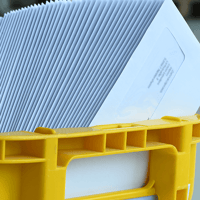


The paper industry has changed in the last decade.
Much of this change is due to what McKinsey calls “a combination of structural and cyclical forces.” The pandemic not only majorly disrupted supply chains but dramatically impacted paper demand. While declining demand for graphic papers has led to mill closures, growth in e-commerce has led to increased demand for packaging papers. More recently, the industry has been affected by global economic uncertainty influenced by factors including U.S. tariffs, inflation and volatile energy costs. If there’s one thing that’s certain in paper lately, it’s change.
Despite the challenges facing the industry, however, the state of paper at Sylvamo is strong. This is why.
Investing in the Global Supply Chain
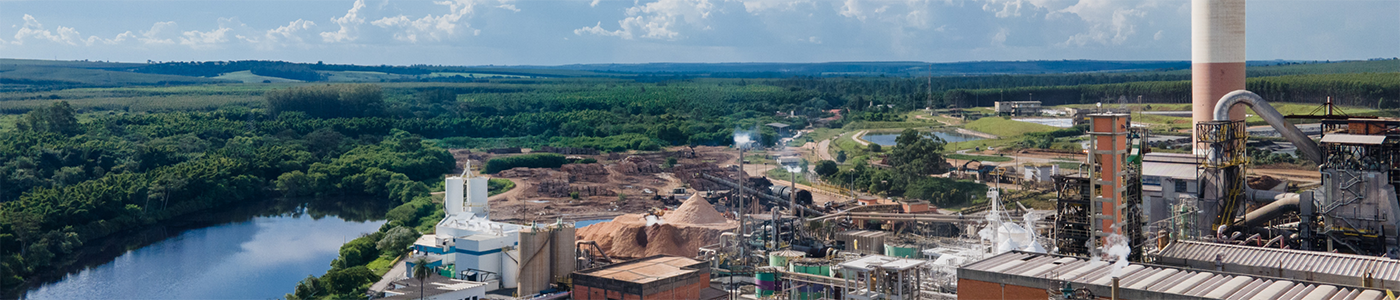
In 2026, an estimated 2.5 to 3.5 million tons of paper production capacity will be lost to mill closures around the world. But while other companies are shuttering mills, Sylvamo is investing in ours.
Earlier this year, Sylvamo launched a $145 million project at our South Carolina facilities.
At the Eastover mill—already one of the most technologically advanced mills in the world—modernization of existing equipment will allow us to produce an additional 60,000 short tons of uncoated freesheet each year.
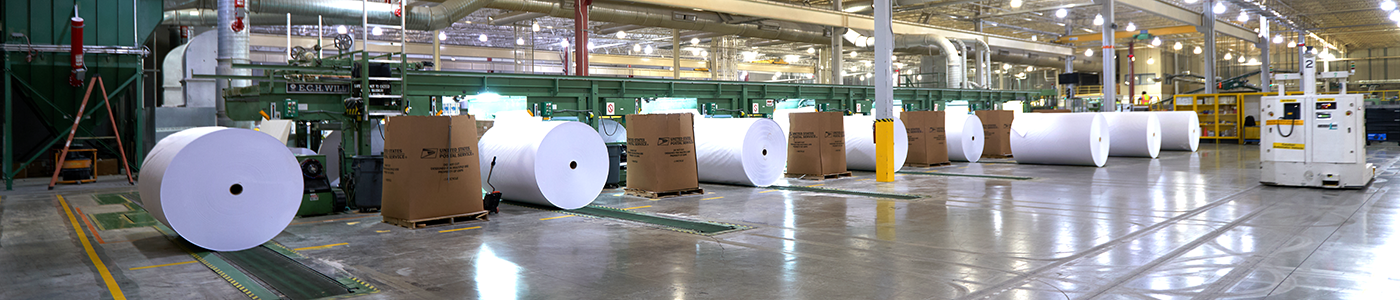
At the Sumter sheeting plant, we are purchasing a state-of-the-art cutsize sheeter that will convert large paper rolls into sheets more efficiently, reducing costs and increasing flexibility to better serve customers.
As we work to expand capacity in North America, we are taking advantage of our global network of mills to meet demand in the United States.
Conversational AI Meets Print
We have bridged the gap between digital technology and print with intelligent paper, and advancements in artificial intelligence have now given us an even greater tool to command consumer attention.
Consumers are inundated with digital ads sending them to static landing pages. On average, they spend just 54 seconds on any given webpage. The difficulty lies in engaging consumers so they stay longer, learn more, and, ultimately, complete a desired action.
By integrating print pieces like postcards and brochures with custom conversational AI agents, sending consumers directly to an AI agent rather than a static page, we can lengthen the consumer’s experience with a particular print piece. Consumers have the opportunity to ask relevant questions and receive real-time answers from an AI agent that has been extensively trained on one unique subject.
The consumer gets value beyond what you can fit on the print piece, leading to more interaction with both the printed material and the digital resource.
These AI agents do not and will not replace print. They do, however, push the boundaries of what print can offer. The content that does not fit on a postcard or flyer can easily be communicated by the AI agent, allowing your customer to share more information without compromising on design.

The Difference Premium Paper Makes
When you choose to print on premium papers like Accent® Opaque, you are choosing to print on a paper that will give you rich colors, excellent ink holdout and ink absorption that you cannot achieve with most coated products.
Psychology is at work as well. A heavier paper like The Heavyweights by Accent Opaque communicates importance at first touch, allowing you to quite literally say something with substance.
And substance matters when fighting for consumer attention in an era where attention spans are shrinking and markets are oversaturated. Choosing a heavier, premium paper creates a more tactile experience for the consumer before design and messaging even come into play.
Committing to Sustainable Paper
Around the world, we have conserved, enhanced or restored more than 41,000 acres of forestland. 100% of our fiber complies with the Forest Stewardship Council® Controlled Wood standard. 86% of the energy at our mills is generated from renewable, carbon-neutral biomass materials.
A commitment to sustainability in the paper industry is crucial to maintaining healthy forests and thriving communities.
By printing on sustainable paper, you are supporting a global movement to maintain natural resources and protect the health of our planet.
The Future of Paper
We are part of an industry that has weathered a lot of change in the past decade, but we are certainly one that is here to stay.
At Sylvamo, we have learned how to harness advancements in artificial intelligence to complement and strengthen print. We have made major investments in our facilities when so many mills are closing. We have learned how to capture attention by uniting AI and paper.
We believe the state of paper—and the future of paper—is bright.
Subscribe to the Accent newsletter for more industry insights.